Imagine two friends who became interested in gold in the same year.
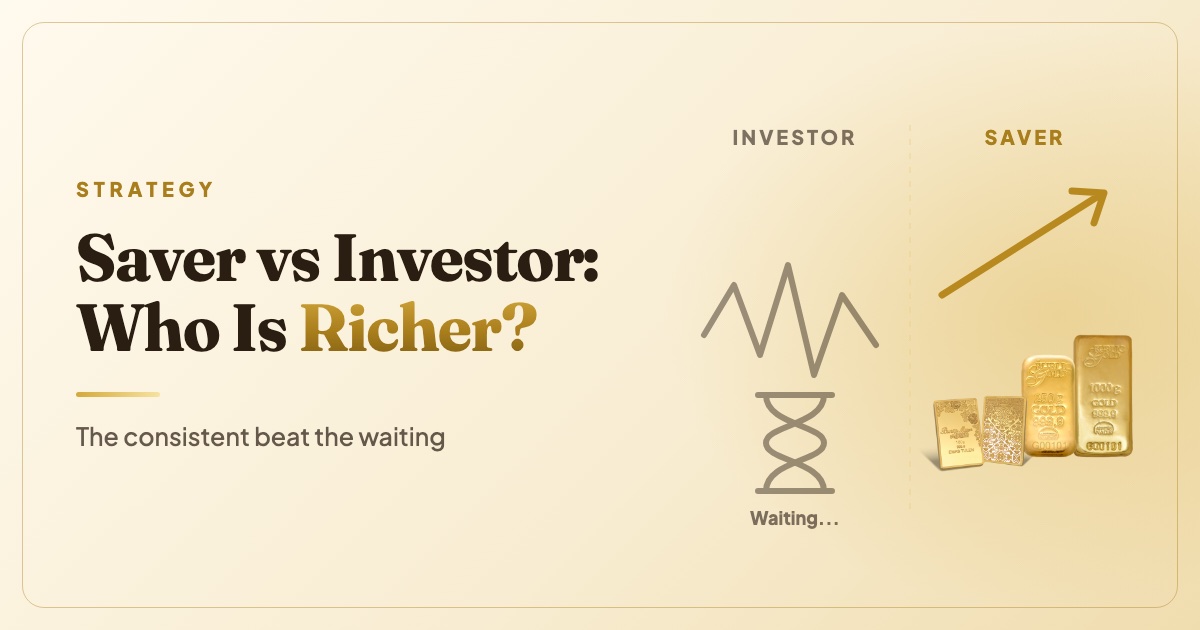
Ali is a gold investor. He watches the price every day, reads market forecasts, and waits for the perfect moment to buy.
Siti is a gold saver. She sets a fixed amount every month and keeps adding gold, whether the price goes up or down.
Ten years later, who owns more gold?
The investor's fate: always waiting
Ali isn't wrong. The principle of "buy low, sell high" is correct and profitable, if you can pull it off. The problem is that it is very hard to do, for two reasons.
1. No one knows the lowest or highest price
We only know a price was "the lowest" after it has risen again. Likewise, "the highest" price is only known after it has fallen. While it is happening, no one can be sure.
2. Emotions take over
When we check the price too often, decisions start being driven by feelings rather than planning. The cycle usually goes like this:
- Price is low: nobody is interested. Gold isn't "exciting" and nobody talks about it.
- Price rises: everyone starts talking about gold. Many buy out of fear of missing out.
- Long-time investors take profit: they sell, and the price falls.
- New investors are disappointed: those who bought at the peak have to wait longer for a profit, and many give up.
In the end, many investors like Ali are stuck in one of two situations: buying when the price is already high, or not buying at all because they are still waiting for the best price. No gold, and the money is gone somewhere too.
The saver's secret: not depending on price
Siti doesn't see gold as an investment to trade. To her, gold is savings, a place to store the value of her hard work.
That is why price swings don't bother her much:
- When the price is high, she still buys, just getting slightly fewer grams.
- When the price is low, she gets more grams for the same amount of money.
She focuses on only one thing: her total grams of gold keep growing. The more gold she owns, the stronger her financial position.
A gold saver doesn't ask "when will the price drop?". She asks "how many more grams can I add this month?"
Why saving works better
Over the long term, the value of the ringgit keeps being eroded by inflation. Historically, the price of gold in ringgit has risen by an average of about 10% a year over roughly 20 years, a total increase of more than 600% over that period.
With this big picture in mind, gold savers don't worry about short-term price swings. They know time is on their side.
The easiest way to become "Siti" is with GAP Auto-Debit: a fixed amount is deducted every month, and you never have to think about the price again.
When you have plenty of gold, other doors open
Gold savings built up over the years are not just for keeping. They can be a stepping stone to:
- Capital to buy property below market value with positive cash flow
- Working capital for a business without borrowing
- Paying off debt faster
Conclusion
Gold investors wait for the perfect price. Gold savers keep adding to their savings. Over the long term, the consistent almost always beat the waiting.
A few years from now, gold savers will look back at today's price and smile, wishing they had saved even more.
Want to become a gold saver? Learn about the benefits of saving gold or tap the WhatsApp button.